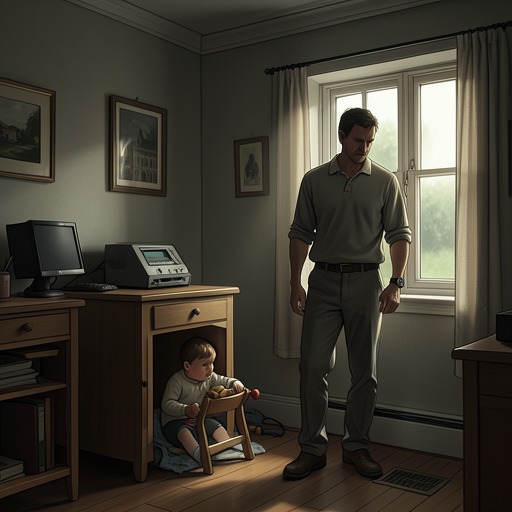
Ethan Russell and Alistair Russell
The Woman in the WindowEthan Russell and Alistair Russell’s relationship is that of an adopted son and his father, but its apparent protectiveness becomes inseparable from anger and concealment. Ethan says he was adopted at five; later, when he tried to pursue contact with a woman who had returned, Alistair reacted with fury and struck him. The relationship’s final reversal comes when Ethan reveals that he killed the woman and that Alistair knew. Alistair’s subsequent confession confirms that Ethan’s account was true, while making clear that his effort to protect his family depended on keeping a consequential secret.
Adoption and Family Position
When Anna Fox asks Ethan when he was adopted, he answers that it happened when he was five. The question places their exchange in the context of his family history: Ethan is Alistair’s son through adoption, and Alistair is the father whose response to Ethan’s later disclosure becomes central to the relationship. The evidence does not explain the circumstances of the adoption, so the article’s account of their earlier bond is limited to this stated fact and Ethan’s later description of Alistair as his father.
The adoption detail gains significance when Ethan recounts a woman’s return after Halloween. He says that they spoke, and that he planned to tell his parents he wanted to see her officially. He also explains that he was nearing seventeen and believed that at eighteen he would be able to make that choice for himself. The conversation therefore makes his attempt to pursue contact a point of emerging independence: he intends to tell his parents rather than simply act without their knowledge.
The Conflict Over Contact
Ethan describes Alistair as furious when he told his parents. Alistair came back and demanded to know where the woman was; Ethan refused to tell him. Ethan then confirms, in response to Anna’s question, that Alistair hit him. The exchange gives the conflict a specific sequence: Ethan announces his wish, Alistair demands information, Ethan withholds it, and the disagreement turns physical. It also distinguishes Alistair’s response from that of Ethan’s mother, whom Ethan says was angry but not as furious as his father.
Anna’s response is to place a hand on Ethan’s shoulder after he confirms what happened. That gesture follows her questions rather than an explanation from Alistair, and the account of the conflict reaches the reader through Ethan’s disclosure to her. The scene presents the father-son relationship indirectly: Alistair is absent, but his demand, Ethan’s refusal, and the reported blow define the immediate terms of their confrontation. Ethan’s account does not describe a reconciliation or establish how they dealt with the violence afterward.
A Murder and a Shared Secret
Later, Ethan tells Anna that after the woman returned, he heard her arguing with Alistair. He says that he went downstairs with a letter opener and killed her. In describing this act, Ethan connects his anger to the larger conflict: he says he hated her for what she had done to him and for not telling him about his father. The account makes the murder a turning point in the relationship between Ethan and Alistair, because the father is present in the surrounding conflict and then becomes bound to the aftermath through his knowledge of the killing.
Ethan says that Alistair made him swear not to tell. He attributes this secrecy to Alistair’s wish to protect his wife, who, according to Ethan, had not been present and did not know what had happened. When Anna suggests that Alistair had tried to protect Ethan from her, Ethan corrects her: Alistair had tried to protect Anna from him. The correction changes the emphasis of Alistair’s apparent protection. It was not simply a father shielding his son from an outside accusation; in Ethan’s account, Alistair understood the danger Ethan posed and sought to keep Anna from it, while still concealing the truth from his wife.
Exposure and Aftermath
Ethan’s disclosure also explains why Alistair’s protective behavior cannot be read as uncomplicated loyalty. Ethan says Alistair made the promise of silence, and later characterizes his father as wanting to protect the family member who did not know. He even says he feels bad for Alistair because of the secret he had to keep from his spouse. These remarks show Ethan acknowledging the burden of concealment without undoing his own responsibility for the killing. The relationship contains both the reported violence of the earlier dispute and a later, uneasy recognition of Alistair’s position.
After Ethan dies, Detective Little visits Anna and tells her that Alistair has been arrested and charged as an accessory to murder. Alistair confesses immediately, and the detective says that what happened was as Ethan had described it. This posthumous confirmation establishes that Ethan’s account of Alistair’s involvement was not merely an accusation made during their final encounter. The evidence does not specify the precise acts that led to the accessory charge, but it does establish Alistair’s knowledge and confession.
Narrative Significance
The relationship is revealed in stages, and each disclosure revises the meaning of the one before it. Adoption first identifies Ethan’s family position; his account of the dispute shows Alistair responding violently to a request for contact; the later confession reveals that father and son shared a secret about a killing; and Alistair’s arrest confirms the account after Ethan can no longer be questioned. The progression turns the ordinary language of parental protection into a question of what, and whom, that protection serves.
For Anna, the relationship becomes legible through Ethan’s statements rather than through any direct conversation with Alistair. The final confirmation from Detective Little supplies independent support for Ethan’s version, but leaves some details unresolved, including what Alistair knew at each stage and what he intended beyond the protection Ethan attributes to him. The resulting portrait is not of a relationship repaired or fully explained: it is one in which adoption, conflict, violence, loyalty, and concealment remain joined, even after the secret is exposed.